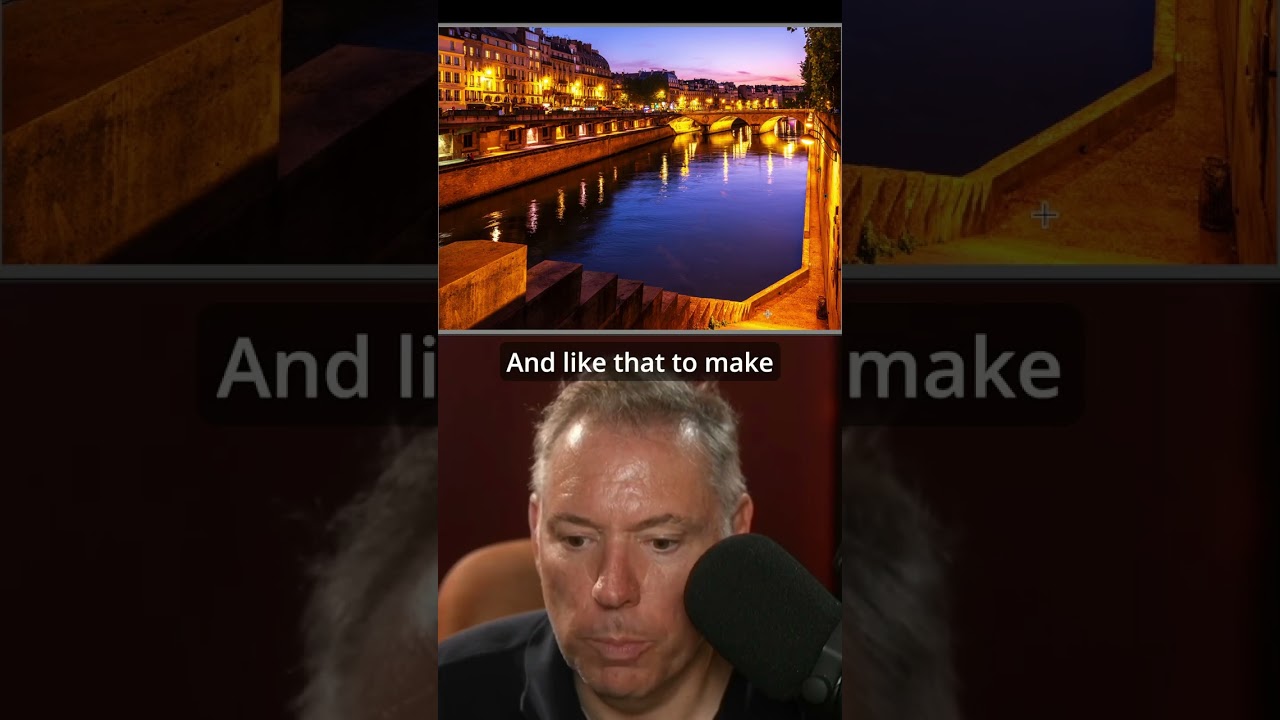
Last month I was shooting a beauty campaign in downtown Portland, and the client wanted “something architectural but not cold.” I kept setting up against clean brick walls and getting exactly that: clean, cold, technically correct, completely lifeless. I knew the problem. I was thinking in single planes. The shot needed depth, a sense of place that didn’t swallow the subject. I’d been sitting on this Serge Ramelli tutorial for weeks and finally watched it the night before our second shoot day. By morning I had a completely different plan.
Why Paris Is Actually a Classroom for Composition
In this Serge Ramelli tutorial filmed entirely on location in Paris, the central argument is elegant: the most compelling travel and portrait images don’t just show you a place. They show you a place inside another place. Ramelli works with the city’s natural architecture, doorways, archways, colonnades, windows, as framing devices that sit between the camera and the subject. The result is an image with a foreground layer, a middle subject layer, and a background layer working together. Three planes of visual information instead of one.
This isn’t a new concept, but what Ramelli does well is make it tactical. He’s not talking about the theory of foreground interest. He’s standing on a specific Parisian street showing you exactly where to position your feet, how close to get to the framing element, and why that proximity matters more than most photographers realize.
Getting Close to the Frame Changes Everything
The technique hinges on one counterintuitive move: get much closer to your framing element than feels natural. Most of us instinctively back up to fit everything in. Ramelli does the opposite. He presses close to the archway or doorframe, sometimes within a foot or two, which does two things simultaneously.
First, it throws the foreground frame into soft, painterly blur. A sharp archway would compete with your subject. A dissolved one acts as a vignette that your eye reads as depth without consciously registering the frame itself. Second, the proximity creates compression between the layers. Your subject in the middle distance suddenly looks more isolated, more intentional, more like they belong in that world rather than being placed in front of a backdrop.
Ramelli shoots this with a longer focal length, in the 85mm to 135mm range, which amplifies the compression. Wide lenses kill this effect. The foreground blur never goes soft enough, and the layers flatten back into a single plane. If you’re attempting this technique, commit to the longer glass.
Reading the Light Before You Touch the Camera
One thing I appreciate about how Ramelli teaches is that he scouts the light before he scouts the frame. He walks the location and identifies where the light falls on the background layer, not the subject. That sounds backward until you understand his logic: the background needs just enough luminosity to separate from the subject without drawing attention. If the background is too bright, the eye exits the frame through it. Too dark, and the image reads as a subject floating in a void.
In Paris, he finds that the warm, indirect golden-hour light bouncing off limestone facades creates this naturally. He positions himself so that the framing element sits in relative shadow, the subject catches the direct warm light, and the background settles into a slightly brighter but diffused tone. The exposure is metered for the subject’s face, which means the frame goes darker and the background stays just luminous enough. That tonal hierarchy is doing most of the compositional work.
For my Portland shoot, I found a covered market entrance with a narrow colonnade. I timed it for late afternoon when the light came through at a low angle. It wasn’t Paris limestone, but the principle transferred completely.
Where This Technique Gets Complicated
I want to be honest about one place where the frame-within-a-frame approach can go wrong, because I’ve watched it fail in my own portfolio. When the framing element and the subject are too similar in tone, the layers merge and the effect collapses. I shot a model in a cream-colored coat once, positioned inside a cream-painted archway, and the image looked like a mistake rather than a composition. The frame disappeared into the subject.
Ramelli’s Paris environment helps him avoid this because the architecture tends to be darker stone or iron compared to skin tones and clothing. If you’re shooting in environments without that natural tonal contrast, you need to either direct your subject’s wardrobe toward something that pops against the architecture, or find a different kind of frame. A darker interior doorway with a bright exterior subject. A shadowed tree canopy over a person standing in a sunlit clearing. The tonal separation has to be there, or you’re just standing close to a wall.
The One Setting Worth Drilling Before You Go
Before you head to any location to try this, spend twenty minutes in your backyard or a nearby street just practicing the focus. Shooting close to a foreground element with a long lens means your autofocus will hunt between the frame and your subject. Ramelli uses back-button focus and locks his subject’s eye deliberately before every frame. He’s not relying on continuous tracking, because continuous tracking will find the nearer edge of the arch and give you a sharp doorframe and a soft face.
Manual focus confirmation, or a single-point AF locked on the eye before you half-press, is the practical fix. Get that muscle memory before you’re in front of a client.
The biggest thing this tutorial gave me was permission to be physically bolder on location. Moving close to architecture, committing to the compression, letting the foreground dissolve. The difference between a competent photo and one that feels alive is usually a matter of two feet and one stop of aperture.
Watch the full video to see Ramelli demonstrate the exact positioning and focal length choices in real time on location in Paris. The visual reference makes the depth relationships click in a way that’s hard to fully convey in words.
Comments (2)
I've been looking for exactly this kind of tutorial. Perfect timing.
Great article! I actually covered something related on my site — the color grading angle is really complementary to this.
Leave a Comment